

| New Threats Detection Added | • ContEXE Stealer • CountLoader |
| New Threat Protection | 10 |
| Newly Detected Threats | 61 |
Weekly Detected Threats
The following threats were added to Crystal Eye this week:
|
Threat name:
|
ContEXE Stealer | |||||||||||||||||||||
|
ContEXE Stealer is an information-stealing malware design to collect sensitive information such as browser-stored credentials, cookies, authentication tokens, system information, and other valuable artifacts. This ContEXE Stealer primarily targets Windows environments and masquerades as legitimate executables (.exe) often being distributed through phishing emails, malvertising, SEO poisoning and trojanised downloads and exfiltrate the stolen data to a Command-and-Control (C2) server.
|
||||||||||||||||||||||
|
Threat Protected:
|
14 | |||||||||||||||||||||
|
Rule Set Type:
|
|
|||||||||||||||||||||
|
Class Type:
|
Domain-c2 | |||||||||||||||||||||
|
Kill Chain:
|
|
|||||||||||||||||||||
Known Exploited Vulnerabilities (Week 2 - October 2026)
For more information, please visit the Red Piranha Forum:
https://forum.redpiranha.net/t/known-exploited-vulnerabilities-catalog-2nd-week-of-october-2026/702.
|
Vulnerability
|
CVSS
|
Description | Affected Version | Fixed Version |
|
7.5
|
Denial of Service - ICS BIND contains a denial-of-service vulnerability that can allow an unauthenticated remote attacker to cause a denial of service via TKEY queries.
|
< 9.9.7-P2
< 9.10.2-P3 |
9.9.7-P2
9.10.2-P3 |
|
|
8.1
|
Unauthenticated RCE - Apache Struts contains a command injection vulnerability that can allow an unauthenticated remote attacker to execute code on the system, exploitation of this vulnerability requires Dynamic Method Invocation to be enabled.
|
2.3.19 - 2.3.20.2
2.3.21 - 2.3.24.1 2.3.25 - 2.3.28 |
2.3.20.2
2.3.24.2 2.3.28.1 |
|
|
7.2
|
Information Disclosure - Strapi contains a vulnerability that can allow an authenticated remote attacker to discover sensitive user details via the query filter which can be used in further attacks. This vulnerability can be chained with CVE-2023-22621 to achieve remote code execution on the system.
|
3.2.1 - 4.7.1
|
4.8.0
|
|
|
9.8
|
Unauthenticated RCE - OPENOFFICE Docs Server contains a path traversal vulnerability that can allow an unauthenticated remote attacker to execute code on the system via uploading an image when using a JWT.
|
<= 5.6.2
|
5.6.3
|
|
|
10.0
|
ProFTPD contains a vulnerability that can allow an unauthenticated remote attacker to read and write arbitrary files on the system via site cpfr/cpto FTP commands.
|
Check vendor advisory for affected products and versions.
|
||
ICS Advisories (Week 2 - October 2026)
|
Vulnerability
|
CVSS
|
Description | Affected Version | Fixed Version |
|
Hitachi Energy
|
RTU500
CVE-2026-8065 (CVSS: 9.1) CVE-2026-8066 (CVSS: 9.1) CVE-2026-8067 (CVSS: 6.5) CVE-2010-2965 (CVSS: 9.8) CVE-2014-9195 (CVSS: 8.1) CVE-2023-46143 (CVSS: 7.5) |
Contains vulnerabilities that can allow an unauthenticated remote attacker to gain access to the system. Additionally, contains vulnerabilities that can allow an unauthenticated attacker upload arbitrary firmware and files, and to execute arbitrary commands via protocol-compliant traffic.
CISA ICS Advisory: icsa-26-279-06 |
<= 11.x
|
12.7.8 or 13.9.1
|
|
Contains vulnerabilities that can allow an authenticated attacker to cause a denial of service condition on the system.
CISA ICS Advisory: icsa-26-279-05 |
Check vendor advisory for affected products and versions.
|
|||
|
Contains a vulnerability within the ActiveMQ component used in the product that can allow an attacker to execute code on the system.
CISA ICS Advisory: icsa-26-279-04 |
2.0.0 – 2.2.0
|
SOI EP2
|
||
|
Contains vulnerabilities that can allow an unauthenticated remote attacker to upload configuration files to the system.
CISA ICS Advisory: icsa-26-279-03 |
<= 9.9.0
|
9.9.1
|
||
|
Savannah
|
Contains a buffer overflow vulnerability that can allow an unauthenticated remote attacker to execute code on the system.
CISA ICS Advisory: icsa-26-279-02 |
Check vendor advisory for affected versions.
|
||
|
Johnson Controls
|
Contains vulnerabilities that can allow an unauthenticated remote attacker to gain access to the system through the use of hard-coded credentials and through brute forcing credentials.
CISA ICS Advisory: icsa-26-279-01 |
<= 2.0b52
|
N/A (End-of-Life)
|
|
|
Red Lion Controls
|
CVE-2026-39460 (CVSS: 9.3)
CVE-2026-28745 (CVSS: 9.3)
CVE-2026-33367 (CVSS: 9.3)
CVE-2026-29797 (CVSS: 8.4)
CVE-2026-39453 (CVSS: 8.5)
CVE-2026-33272 (CVSS: 6.8)
|
Contains vulnerabilities that can allow an unauthenticated remote attacker to access the system with default credentials. Additionally, credentials stored within the configuration utilise weak encryption and contains vulnerabilities that can allow an attacker to perform administrative actions through SNMP and TFTP without authentication.
|
<= Firmware_3.11.0
<= Bootloader_2.0.6.1 |
3.11.1
|
|
Grid Protection
Alliance |
openPDC and openHistorian
CVE-2026-100730 (CVSS: 9.8) CVE-2026-105281 (CVSS: 7.5) CVE-2026-85479 (CVSS: 5.3) CVE-2026-101022 (CVSS: 4.3)
CVE-2026-105278 (CVSS: 9.8)
CVE-2026-104629 (CVSS: 8.8)
|
Contains a deserialisation vulnerability that can allow an unauthenticated remote attacker execute code on the system, allow an attacker to access the system via default credentials, and interact with the system through STTP and Modbus without authentication.
|
openPDC: < 2.9.482
openHistorian: < 2.8.585 |
2.9.482
2.8.585 |
|
Satel
|
Netco Design
CVE-2026-105269 (CVSS: 6.8) CVE-2026-104628 (CVSS: 6.5) CVE-2026-105275 (CVSS: 4.3) CVE-2026-101024 (CVSS: 8.8) |
Contains vulnerabilities that can allow an authenticated remote attacker to access system files through path traversal vulnerabilities which may lead to code execution on the system. Additionally, a stored cross-site scripting vulnerability exists which can result in the execution of JavaScript when viewed.
|
< v2.1.7
|
v2.1.7
|
Updated Malware Signature (Week 2 - October 2026)
|
Threat
|
Description |
|
Remus Stealer
|
Remus Stealer is information-stealing malware that emerged in early 2026 and is considered and evolution of the Lumma Stealer malware family. Remus stealer targets Chromium and Firefox-based browsers to harvests browser credentials, cookies, cryptocurrency wallet information, authentication tokens, and other valuable data. This Remus Stealer commonly distributed through ClickFix social engineering campaigns, malicious advertisements and compromised websites.
|
| Ransomware Report | |
|
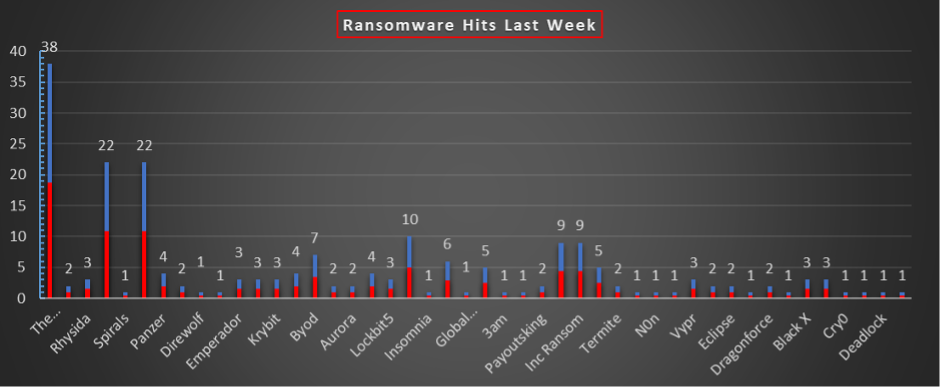
The Red Piranha Team conducts continuous surveillance across the dark web and other threat intelligence channels to identify global organisations impacted by ransomware attacks. In the past week, this monitoring revealed multiple ransomware incidents spanning a diverse range of threat groups, underscoring the persistent and widespread nature of today's cyber threat landscape. Presented below is a detailed breakdown of ransomware group activity, victim geographies, and targeted industries observed during this period. Ransomware Hits Last WeekWorldwide ransomware victim distribution by threat group shows that The Gentlemen was the most active group, with 38 victims, accounting for 18.72% of total reported ransomware activity. Qilin and NightSpire jointly recorded the second-highest number of victims, with 22 cases each, representing 10.84% individually. Together, these three groups accounted for a substantial proportion of reported ransomware victims during the period. SafePay recorded 10 victims, representing 4.93% of the total. Umbra and Inc Ransom each reported 9 victims, contributing 4.43% individually. Byod recorded 7 victims (3.45%), while LeakedData reported 6 victims (2.96%). Everest and Akira each recorded 5 victims, accounting for 2.46% individually. Other groups with moderate activity included Panzer, Interlock, and Lamashtu, each reporting 4 victims, representing 1.97% individually. Rhysida, Emperador, Storm, Krybit, Lockbit5, Vypr, Black X, and Arcus Media each recorded 3 victims, contributing 1.48% individually. Several ransomware groups recorded 2 victims each, accounting for 0.99% individually. These included Wallstreet, Play, Doommageddon, Aurora, Payoutsking, Termite, Anubis, Eclipse, and DragonForce. The remaining groups recorded 1 victim each, representing 0.49% individually. These included Spirals, Direwolf, Booba Team, Insomnia, Global Secret Group, 3am, Endzone, Shiba, N0n, Vexy, Run Some Wares, Payload, Cry0, Bravox, Deadlock, and Brain Cipher. |
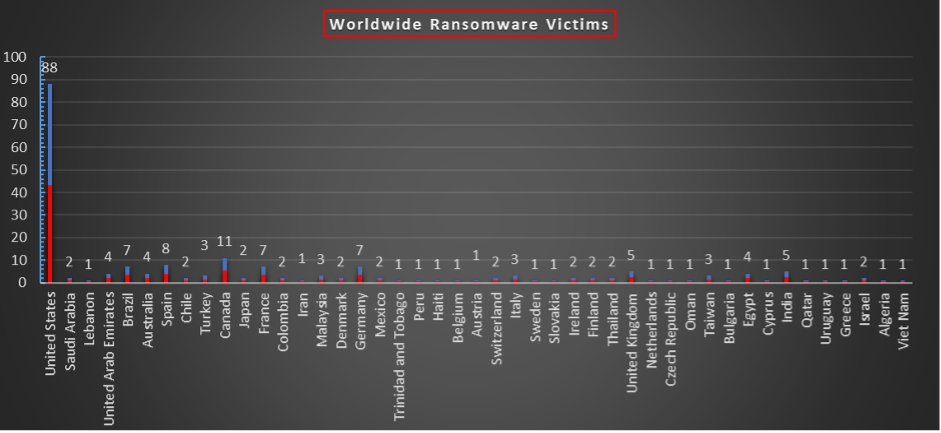
Worldwide Ransomware Victims
Worldwide ransomware victim distribution shows that the United States was the most affected country, with 88 victims, accounting for 43.35% of total ransomware activity. This indicates that more than two-fifths of all reported ransomware victims were located in the United States.
Canada recorded the second-highest number of victims, with 11 cases, representing 5.42% of the total. Spain followed with 8 victims, accounting for 3.94%. Brazil, France, and Germany each 7 victims, contributing 3.45% individually. India and the United Kingdom each recorded 5 victims, repreenting 2.46% of overall ransomware activity.
Other countries with notable ransomware impact included the United Arab Emirates, Australia, and Egypt, each reporting 4 victims, accounting for 1.97% individually. Turkey, Malaysia, Italy, and Taiwan each recorded 3 victims, representing 1.48% of the total ransomware activity.
Several countries reported 2 victims each, accounting for 0.99% individually. These included Saudi Arabia, Chile, Japan, Colombia, Denmark, Mexico, Switzerland, Ireland, Finland, Thailand, and Israel.
The remaining countries recorded 1 victim each, representing 0.49% individually. These included Lebanon, Iran, Trinidad and Tobago, Peru, Haiti, Belgium, Austria, Sweden, Slovakia, the Netherlands, the Czech Republic, Oman, Bulgaria, Cyprus, Qatar, Uruguay, Greece, Algeria, and Vietnam.
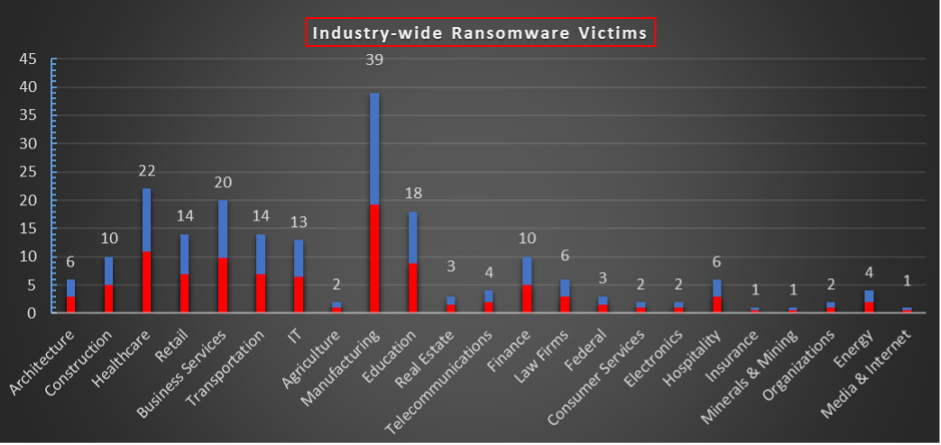
Industry-wide Ransomware Victim
Industry-wide ransomware victim distribution shows that Manufacturing comprised of 39 victims, accounting for 19.21% of total reported ransomware activity. This makes manufacturing the leading targeted industry in the dataset, highlighting the significant exposure of industrial organisations to ransomware attacks.
Healthcare recorded the second-highest number of victims, with 22 cases, representing 10.84% of the total. Business Services followed with 20 victims, accounting for 9.85%, while Education recorded 18 victims, representing 8.87% of overall ransomware activity.
Other significantly affected industries included Retail and Transportation, each reporting 14 victims, contributing 6.90% individually. The IT sector recorded 13 victims, accounting for 6.40%. Construction and Finance each reported 10 victims, representing 4.93% individually.
Moderate ransomware activity was observed in Architecture, Law Firms, and Hospitality, each recording 6 victims, accounting for 2.96% individually. Telecommunications and Energy each reported 4 victims, representing 1.97%. Real Estate and the Federal sector each recorded 3 victims, contributing 1.48% individually.
Several industries reported 2 victims each, accounting for 0.99% individually. These include Agriculture, Consumer Services, Electronics, and Organisations.
The remaining industries recorded 1 victim each, representing 0.49% individually. These include Insurance, Minerals & Mining, and Media & Internet.
Black X Ransomware
Group Overview
Last Week Black X posted three organisations to its leak site, all on 9 October 2026: Bayer (Germany, life sciences), enTouch (Japan, IT for the pharmaceutical sector) and Lopay (United Kingdom, payments). The enTouch post claims the full data.entouch.jp customer and consultation database, while the Bayer post describes no stolen data. None of the claims has been confirmed by the victim, a regulator or the media. [1][2]
Black X runs a double-extortion leak site and is profiled as crypto-ransomware first seen in May 2025, although public reporting of the leak site only began in May 2026. Earlier victims are concentrated in South Korea, including car-parts maker IWIN, with others in Vietnam, South Africa and Yemen. [2][3][5][6]
Technical Analysis
No Black X malware sample, hash, ransom note or file extension is publicly available, so its encryption and intrusion behaviour cannot be confirmed. [3]
MITRE ATT&CK Mapping
The techniques below come from aggregator listings and infostealer exposure data. None is backed by a sample or incident report, so treat them as hunting leads rather than confirmed Black X behaviour. [4][12]
|
Tactic
|
Technique
|
Evidence decision
|
|
Initial Access
|
T1078 Valid Accounts
|
Infostealer exposure exists for Bayer and enTouch domains, but no source links it to these intrusions. Listed by SOCRadar without evidence. [2][4]
|
|
Execution
|
T1059 Command and Scripting Interpreter
|
Aggregator listing only; no sample or process evidence. [4]
|
|
Defence Evasion
|
T1562 Impair Defences
|
Aggregator listing only; no security-tool tampering evidence. [4]
|
|
Credential Access
|
T1003 OS Credential Dumping
|
Aggregator listing only; no dumping tool or artifact evidence. [4]
|
|
Impact
|
T1490 Inhibit System Recovery
|
Aggregator listing only; no recovery-tampering evidence. [4]
|
Indicators and Contextual Observables
Only the leak-site onion address is strongly associated with Black X. The IP address comes from a single unverified source and should be treated as a hunting lead. [1][3][7][9]
|
Type
|
Defanged value
|
|
DLS onion
|
blackxppq2jvqyg4slyg3sbszv7ib2avaaycvhff5qipgdoepqi57xyd[.]onion
|
|
Email
|
blackx2025[@]proton[.]me
|
|
Telegram
|
hxxps://t[.]me/blackx008
|
|
Tox ID
|
15BDB8A1984315C5BCC85350833DF4DDE307E41B5D84A1050D3D402F929260619B5033B5547B
|


Public Platform Validation
|
Object
|
Result
|
Assessment
|
|
Onion domain (OTX)
|
1 user-created pulse from a social-media feed; no files or passive DNS. [8]
|
Community association only.
|
|
ANY.RUN task 40f9c069
|
Browser visit of the Bayer listing URL; Tor DNS-policy alerts only. [10]
|
Not a malware detonation.
|
|
VirusTotal, MalwareBazaar, ThreatFox
|
Blocked by CAPTCHA or browser verification.
|
Collection gap; re-check with an authenticated account.
|
Detection Opportunities
No Black X payload telemetry is public, so these detections target the claimed behaviour: theft of database and payment records. [2][11]
- Alert on unusual queries, exports and after-hours access to CRM, consultation, customer and payment-transaction databases, especially by accounts that do not normally use them. [2][11]
- Correlate large archive creation, staged exports, cloud-sync activity and sustained outbound transfer from database, application or file servers. [11]
- Alert on Tor client traffic and .onion DNS queries from corporate hosts; ANY.RUN raised Tor DNS-policy alerts when the leak-site URL was opened. [10]
- Hunt firewall, proxy and NetFlow history for 172.86.110[.]111 and TCP 4000 as a low-confidence lead, and escalate only when hits correlate with other intrusion signals. [7][9]
- Monitor for compromised-credential use: new devices, impossible travel, MFA changes and session reuse for accounts that appear in infostealer exposure data. [2]
Mitigation and Remediation Recommendations
- Require phishing-resistant MFA for remote access, privileged administration, email, SaaS and partner portals; rotate exposed credentials and invalidate active sessions. [11]
- Segment customer-data, payment and database systems from user networks and internet-facing services; allow only documented flows. [11]
- Restrict bulk exports and cloud uploads from systems holding customer, clinical or payment data; apply least privilege and approval for high-volume exports. [11]
- Maintain offline or immutable backups, protect backup credentials separately, and test restoration of critical services. [11]
- Organisations that use enTouch, Lopay or Bayer services should request a supplier security statement and review data shared with those platforms while the claims remain unverified.
- If a claim is received, preserve memory, endpoint and server images, authentication, database and firewall logs and the exact operator communication before reimaging, and do not engage the operator without legal and incident-response guidance. [11]
Crystal Eye CE 6.0 Mitigation and Remediation
The following Crystal Eye controls address the claimed data theft and the unknown initial-access path.
- Reduce exposed attack paths - Use Advanced Firewall zones and permit-by-exception rules for internet-facing, database, payment, management and backup networks.
- Detect suspicious access or exploit traffic - Apply IDPS policies to exposed and high-value segments, enable event logging, and add local rules for validated indicators.
- Control anonymizers and leak-site access - Use Web Filter profiles, banned categories and custom policies to block Tor gateways, anonymizers and .onion proxy services.
- Correlate a leak claim with telemetry - Use Threat Hunt top-user, top-device, external-IP and upload-volume views to baseline and investigate spikes from database and payment systems.
- Escalate validated high-risk alerts - Use AI and Escalation Reports and Incident Response Services to escalate relevant IDPS and AV alerts to the Security Operations Team.
Confidence Assessment
|
Assessment
|
Confidence
|
Reason
|
|
Black X posted three unique in-window claims
|
HIGH
|
RansomLook and Ransomware.live list Bayer, enTouch and Lopay on 9 October 2026. [1][2]
|
Known Intelligence Gaps
- No victim confirmation, data sample or data volume is available for any of the three listings. [2]
- No malware sample, ransom note, extension or behaviour report is public, so no technique is confirmed. [3][4]
- No ransom demand, payment or wallet evidence was found, and trackers disagree on victim counts (14 to 20) and first-seen dates. [1][2][3][4]
Source References
[1] RansomLook Black X group page. https://www.ransomlook.io/group/black%20x
[2] Ransomware.live Black X group and victim records. https://www.ransomware.live/group/Black%20X
[3] WatchGuard Ransomware Tracker: Black X. https://www.watchguard.com/wgrd-security-hub/ransomware-tracker/black-x
[4] SOCRadar Black X ransomware group profile. https://socradar.io/free-tools/ransomware-intelligence/groups/black-x
[5] AhnLab ASEC August 2026 Threat Trend Report on Ransomware. https://asec.ahnlab.com/en/95567/
[6] VECERT Analyzer post on BlackX emergence, 12 May 2026. https://x.com/VECERTRadar/status/2054251242214293849
[7] RansoMonitor post crediting Barricade Cyber Solutions, 2 June 2026. https://www.linkedin.com/posts/ransomonitor_cti-threatintel-ransomware-activity-7467637472126980096-YLKV
[8] AlienVault OTX indicator and pulse for the Black X onion domain. https://otx.alienvault.com/indicator/domain/blackxppq2jvqyg4slyg3sbszv7ib2avaaycvhff5qipgdoepqi57xyd.onion
[9] AlienVault OTX indicator: 172.86.110.111. https://otx.alienvault.com/indicator/ip/172.86.110.111
[10] ANY.RUN public task 40f9c069-4fae-434e-a3e8-05ef6d7b0cb7. https://app.any.run/tasks/40f9c069-4fae-434e-a3e8-05ef6d7b0cb7/
[11] CISA StopRansomware Guide. https://www.cisa.gov/stopransomware/ransomware-guide
[12] MITRE ATT&CK Enterprise matrix. https://attack.mitre.org/matrices/enterprise/