

| New Threats Detection Added | • BlueMoon EK • AdFection • PUP • TryNodeRAT |
| Newly Detected Threats | 11 |
| New IDPS Rules Created | 97 |
Weekly Detected Threats
The following threats were added to Crystal Eye this week:
|
Threat name:
|
BlueMoon EK | ||||||||||||||||||||||||
|
BlueMoonEK is a modular exploit kit that chains exploit together to compromise Google Chrome browsers and Microsoft Windows systems. This exploit chain achieves remote code execution and serves as an access and payload delivery mechanism. BlueMoonEK commonly distributes through spear-phishing emails containing malicious links that redirect users to a compromised/malicious website, triggering exploitation in a vulnerable browser.
|
|||||||||||||||||||||||||
|
Threat Protected:
|
03 | ||||||||||||||||||||||||
|
Rule Set Type:
|
|
||||||||||||||||||||||||
|
Class Type:
|
Trojan-activity | ||||||||||||||||||||||||
|
Kill Chain:
|
|
||||||||||||||||||||||||
Known Exploited Vulnerabilities (Week 3 - October 2026)
For more information, please visit the Red Piranha Forum:
https://forum.redpiranha.net/t/known-exploited-vulnerabilities-catalog-3rd-week-of-october-2026/704.
|
Vulnerability
|
CVSS
|
Description | Affected Version | Fixed Version |
|
9.8
|
Unauthenticated RCE - BeyondTrust Remote Support contains an authentication bypass vulnerability that can allow an unauthenticated remote attacker to perform file operations on the system, exploitation of this vulnerability could allow an attacker to upload a webshell on the appliance.
|
<= 26.2.3
|
BT26-05-RS
|
|
|
5.4
|
Path Traversal - Multiple Fortinet products contain a path traversal vulnerability that can allow an authenticated attacker with administrative privileges to write or delete arbitrary files. Exploitation of this vulnerability can allow an attacker to escalate to root level privileges enabling further attacks on the system.
|
Check vendor advisory for affected products and versions.
|
||
|
9.3
|
Path Traversal - Multiple Atlassian products contain a path traversal vulnerability that can allow an unauthenticated remote attacker to read files within the application web root which may contain sensitive information and can result in further attacks against the system.
|
Check vendor advisory for affected products and versions.
|
||
|
10.0
|
Authenticated RCE - Ahsay AhsayCBS contains a path traversal vulnerability that can allow an authenticated remote attacker to upload and execute files on the system, exploitation of this vulnerability can allow an attacker to upload a webshell allowing access to the underlying operating system. This vulnerability can be chained with CVE-2026-105133 (Authentication Bypass).
|
<= 10.3.2
|
10.3.4
|
|
|
9.8
|
Unauthenticated RCE - Cisco Secure Email Gateway contains a path traversal vulnerability that can allow an unauthenticated remote attacker to write arbitrary files on the underlying operation system. This vulnerability can be exploited by sending a specially crafted attachment through an affected device, allowing for code execution with root level privileges.
|
Check vendor advisory for affected products and versions.
|
||
|
7.3
|
Authentication Bypass - Ahsay AhsayCBS contains an authentication bypass vulnerability that can allow an unauthenticated remote attacker to gain access to the system through the creation of an administrative user. This vulnerability can be chained with CVE-2026-105134 (Path traversal) to achieve unauthenticated code execution on the system.
|
<= 10.3.2
|
10.3.4
|
|
|
8.6
|
Authenticated RCE - Palo Alto Networks PAN-OS contains a vulnerability that can allow an authenticated remote attacker with network access to execute arbitrary code on the system with root level privileges.
|
Check vendor advisory for affected products and versions.
|
||
|
8.6
|
Unauthenticated RCE - Ivanti Connect Secure contains an authentication bypass vulnerability that can allow an unauthenticated remote attacker to upload and execute code on the system.
|
Check vendor advisory for affected versions.
|
||
|
8.8
|
Unauthenticated RCE - Microsoft Windows Shell contains a command injection vulnerability that can allow an unauthenticated remote attacker to bypass Mark of the Web (MOTW) and execute code on a system when a user opens a specially crafted file.
|
Check vendor advisory for affected products and versions.
|
||
ICS Advisories (Week 3 - October 2026)
|
Vulnerability
|
CVSS
|
Description | Affected Version | Fixed Version |
|
J4Care
|
CVE-2026-101021 (CVSS: 7.5)
CVE-2026-105279 (CVSS: 9.1)
CVE-2026-105667 (CVSS: 7.5)
|
Contains vulnerabilities that can allow an unauthenticated attacker to delete stored medical images, access patient information, overwrite files and cause a denial of service through parsing specially crafted streams.
|
5.35.1
|
5.35.2
|
|
Thermo Fisher
|
Torrent Suite Software
CVE-2026-107777 (CVSS: 6.5)
|
Contains a path traversal vulnerability that can allow an authenticated attacker to read arbitrary files on the system.
|
<= 5.18
|
5.22
|
|
Guangzhou Juan IoT Technology
|
EseeCloud
CVE-2026-107617 (CVSS: 9.8)
CVE-2026-97858 (CVSS: 5.3)
CVE-2026-105664 (CVSS: 5.3)
|
Contains vulnerabilities that can allow an unauthenticated remote attacker gain access to the system through the use of hard-coded credentials.
CISA ICS Advisory: icsa-26-288-02 |
App: <= 4.9.6
Firmware: <= 4.9.86.0
|
N/A
|
|
Eclipse Foundation
|
Eclipse Milo
CVE-2026-62927 (CVSS: 7.5)
CVE-2026-63252 (CVSS: 7.5)
CVE-2026-58080 (CVSS: 8.2)
CVE-2026-63248 (CVSS: 6.5)
CVE-2026-60007 (CVSS: 7.4)
CVE-2026-61387 (CVSS: 5.3)
|
Contains vulnerabilities that can allow an unauthenticated attacker to access sensitive information and user credentials through a padding oracle vulnerability, impersonate users and create denial of service condition preventing the server to respond to clients.
CISA ICS Advisory: icsa-26-288-01 |
1.0.0 – 1.1.4
|
1.1.5
|
|
Swann Communications
|
SWIFI-SE2KIC
CVE-2026-107605 (CVSS: 6.2)
CVE-2026-107606 (CVSS: 6.2)
CVE-2026-107607 (CVSS: 6.2)
|
Contains vulnerabilities that can allow an unauthenticated attacker within the network to view live video feeds without authentication.
CISA ICS Advisory: icsa-26-286-02 |
<= 2.0.22
|
N/A
|
|
Inductive Automation
|
Ignition Software
CVE-2026-92817 (CVSS: 8.8)
|
Contains a privilege escalation vulnerability that can allow an authenticated attacker with low privileges to escalate their privileges which can result in code execution on the system.
CISA ICS Advisory: icsa-26-286-01 |
8.1.0 – 8.1.54
8.3.0 – 8.3.8
|
8.1.55
8.3.9
|
Updated Malware Signature (Week 3 - October 2026)
|
Threat
|
Description |
|
Shai-Hulud
|
Shai-Hulud is a self-propagating supply chain malware that targets npc ecosystem by compromising JavaScript and TypeScript developers and maliciously modifying legitimate package to spread the infection. Upon infection, it will scan local machine and CI-CD pipelines to steals sensitive data such as API keys, cloud credentials (AWS, Azure, GCP) and GitHub Tokens then exfiltrates them to attacker-controlled infrastructure.
|
| Ransomware Report | |
|
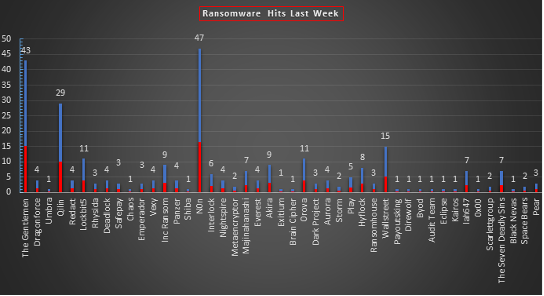
The Red Piranha Team conducts continuous surveillance across the dark web and other threat intelligence channels to identify global organisations impacted by ransomware attacks. In the past week, this monitoring revealed multiple ransomware incidents spanning a diverse range of threat groups, underscoring the persistent and widespread nature of today's cyber threat landscape. Presented below is a detailed breakdown of ransomware group activity, victim geographies, and targeted industries observed during this period. Ransomware Hits Last WeekRansomware victim distribution by threat group shows that N0n was the most active group, with 47 victims, accounting for 16.49% of total reported ransomware activity. The Gentlemen recorded the second-highest number, with 43 victims, representing 15.09% of the total. Qilin ranked third with 29 victims, accounting for 10.18% of reported activity. Wallstreet recorded 15 victims (5.26%), while Lockbit5 and Orova each reported 11 victims, representing 3.86% individually. Inc Ransom and Akira each recorded 9 victims (3.16%), followed by Hyflock, with 8 victims (2.81%). Other groups with notable activity included Majinahanashi, Iah647, and The Seven Deadly Sins, each reporting 7 victims, accounting for 2.46% individually. Interlock recorded 6 victims (2.11%), while Play reported 5 victims (1.75%). Several groups recorded 4 victims each, representing 1.40% individually. These included DragonForce, Redact, Deadlock, Vexy, Panzer, Nightspire, Everest, and Aurora. Rhysida, SafePay, Emperador, Dark Project, Ransomhouse, and Pear each reported 3 victims, accounting for 1.05% individually. Metaencryptor, Storm, Scarlettgroup, and Space Bears each recorded 2 victims, representing 0.70% individually. The remaining groups recorded 1 victim each, accounting for 0.35% individually. These included Umbra, Chaos, Shiba, Exitium, Brain Cipher, Payoutsking, Direwolf, Byod, Audit Team, Eclipse, Kairos, 0x00, and Black Nevas. |
Worldwide Ransomware Victims
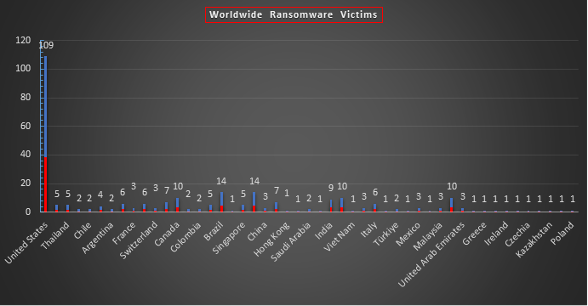
The United States was the most affected country, accounting for 109 ransomware victims (38.25%) worldwide. Brazil and South Korea followed with 14 victims each (4.91%), while Canada, the United Kingdom, and Sweden each recorded 10 victims (3.51%). India reported 9 victims (3.16%), highlighting the continued impact of ransomware across major economies.
Among the other significantly affected countries, Germany and Japan recorded 7 victims each (2.46%). Australia, Spain, and Italy each reported 6 victims (2.11%). Taiwan, Thailand, Indonesia, and Singapore each accounted for 5 victims (1.75%), while Peru recorded 4 victims (1.4%).
Several countries reported smaller but notable numbers of ransomware victims. France and Switzerland each recorded 3 victims (1.05%), as did China, Ecuador, Mexico, Malaysia, and the United Arab Emirates. Egypt, Chile, Argentina, Morocco, Colombia, Saudi Arabia, and Türkiye each reported 2 victims (0.7%).
The remaining countries each recorded 1 ransomware victim (0.35%). These included Turkey, Hong Kong, the Netherlands, Kuwait, Vietnam, Norway, Mongolia, Bangladesh, the Philippines, Greece, Vanuatu, Ireland, Pakistan, Czechia, South Africa, Kazakhstan, Costa Rica, and Poland.
Industry-wide Ransomware Victim
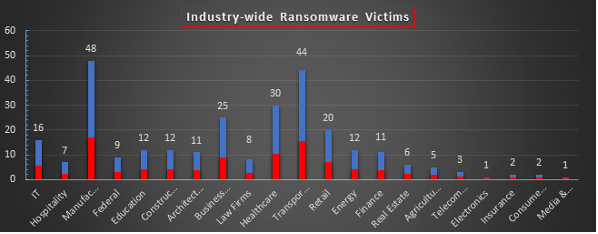
Manufacturing was the most affected industry, accounting for 48 ransomware victims (16.84%). Transportation followed closely with 44 victims (15.44%), while Healthcare recorded 30 victims (10.53%). Business Services accounted for 25 victims (8.77%), and Retail reported 20 victims (7.02%), highlighting the significant impact of ransomware across key commercial and operational sectors.
The IT industry recorded 16 victims (5.61%). Education, Construction, and Energy each reported 12 victims (4.21%), while Architecture and Finance each accounted for 11 victims (3.86%). The Federal sector recorded 9 victims (3.16%), followed by Law Firms with 8 victims (2.81%) and Hospitality with 7 victims (2.46%).
Among the industries with lower victim counts, Real Estate reported 6 victims (2.11%), while Agriculture accounted for 5 victims (1.75%). Telecommunications recorded 3 victims (1.05%). Insurance and Consumer Services each reported 2 victims (0.7%), while Electronics and Media & Internet each recorded 1 victim (0.35%).
Overall, the data indicates that ransomware activity was concentrated in Manufacturing, Transportation, and Healthcare, which together accounted for 42.81% of reported victims. Business Services and Retail also experienced substantial impact. The distribution across a broad range of industries demonstrates that ransomware poses risks to both critical operational sectors and organisations providing essential commercial, public, and professional services.
Cinder Ransomware
Group Overview
Red Piranha identifies Cinder as a data-extortion group, not an encrypting ransomware operation. Its leak site ('cinder', tagline 'unresolved mistakes kept here') carried its first listings on 20 August 2026. Trackers index it as iah6477 / Iah647. No encryptor, ransom note, file extension or sample exists; WatchGuard classes it as a data broker. [1][2][5]
Cinder does not appear to be a new actor. Arctic Wolf assesses with moderate confidence that it is a rebrand or continuation of an earlier extortion brand called Pink, because organisations listed on the Cinder leak site overlap with victims of phishing infrastructure attributed to Pink. Arctic Wolf tracks Pink, Cinder and the related brands BlackFile, Redact and Helix together under a single cluster identifier, PREY-0058; Google tracks the same activity as UNC6671. These are vendor tracking labels for one loosely connected group of cloud-extortion crews, not separate malware families. Arete reports that BlackFile renamed itself Redact in May 2026 and that Pink, Helix and Cinder then appeared as offshoots of that operation. Google and Microsoft have both published on this ecosystem, but neither names Cinder directly, and Arctic Wolf cautions that the brand names may represent affiliates or short-lived rebrands rather than one proven actor. Confidence in the lineage is therefore rated MEDIUM. [6][7][8]
No incident response report specific to Cinder has been published, so the intrusion method below is what Arctic Wolf and Microsoft have documented for the wider cluster Cinder belongs to. The operators do not break in with malware; they talk their way in. They telephone executives while posing as the company IT help desk and direct them to a fake Microsoft 365 sign-in page that silently relays the real login, capturing the password, the MFA approval and the resulting session token. That token is then replayed from residential proxy addresses, often in the victim’s own region, so the login looks like the executive working from home. Once inside the tenant, the actors map the Entra ID directory and SharePoint sites, then use scripted Microsoft Graph and HTTP clients to bulk-download SharePoint, OneDrive, Exchange mailboxes and any connected SaaS platforms. No endpoint malware and no lateral movement between hosts have been observed in these cases. The leak archives on Cinder’s site are consistent with this picture: every captured listing is organised as an entra_id\ directory and an m365\ directory, which is what a tenant-level cloud download produces rather than a file-server encryption. [1][6][9]
Extortion timeline: Cinder applies pressure through its leak site rather than through encryption. When a victim is added, the listing is first marked ‘soon’ with a countdown of roughly two to seven days; this is the window in which the victim is expected to pay. If no settlement is reached, the status changes to ‘public’ and the stolen data is packaged into a download bundle that anyone visiting the site can retrieve. The bundle stays available for a fixed hosting period: listings from August 2026 were published for about 30 days, while listings from October 2026 state that they will remain online for 365 days. [2][5][6]
Ransom: no Cinder-specific demand is public. Google reports ecosystem demands of 1 to over 3 million USD and settlements averaging about 750,000 USD. Largest single claimed volume: 4.2 TiB, with sixteen listings totalling about 17.9 TiB. Victims: almost all of the United States, led by manufacturing and food production, then professional services, retail, real estate and finance. [1][2][3][5][8]
Technical Analysis
There is no Cinder malware sample and no public incident-response report on a Cinder intrusion, so there is no binary to analyse, and no first-hand account of how the group operates inside a network. The attack path described below is therefore drawn from what Arctic Wolf, Google and Microsoft have documented for the PREY-0058/UNC6671 cluster that Cinder belongs to. We apply it to Cinder at MEDIUM confidence: the vendor evidence is strong for the cluster, and the layout of Cinder’s own leak archives matches what this method produces, but no vendor has yet traced a specific Cinder victim through the full chain. [6][8][9]
Initial foothold
Social engineering of staff by telephone, impersonating the IT help desk, leading to a credential-harvesting login page that also defeats MFA. No exploit, edge device or malware is involved. [6][8][9]
Access and persistence
Once the attackers hold a valid session, they sign in as the employee, but they do so through residential proxy services, which route their traffic through ordinary home internet connections in the victim’s own country or city. To Microsoft 365, the activity therefore looks like the employee working from home rather than a login from a foreign data centre, and location-based alerts are not triggered. To make sure they are not locked out when the stolen session expires, or the password is reset, the attackers register an additional MFA method of their own, such as a new authenticator app or passkey, on the compromised account. Because no malware is installed on any device, nothing is left for endpoint security tools to find; the only trace of the intrusion is in the account’s sign-in and audit logs. [6][8][9]
Discovery
With a working login in hand, the attackers’ next step is to find out what the tenant contains. They query the Entra ID directory to list users, groups and roles, and browse the SharePoint and OneDrive sites and mailboxes the compromised account can reach, building a picture of where the valuable data sits. Cinder’s own leak archives carry a fingerprint of this stage: every captured listing includes an entra_id\ directory of between 10 and 235 MB, which is the size and shape of an exported copy of the directory itself rather than of user files. [1][6][9]

Collection and exfiltration
The attackers then copy the data out in bulk. Rather than opening files one by one, they use scripted clients against Microsoft’s own APIs to pull entire SharePoint sites, OneDrive libraries, Exchange mailboxes and any connected business platforms, so a whole tenant can be drained in hours. Cinder’s leak pages show the scale: the seven in-window listings claim between 130 GiB and 2.6 TiB per victim, with file counts of up to 2.3 million. On every archive, the bulk of this sits in an m365\ directory, and one archive also contains folders named after a construction-management and a contract-management platform, which is what this stage produces when the victim has connected those services to its Microsoft tenant. No Cinder-specific network logs or transfer records have been published, so the volumes remain operator claims. [1][6][9]
Extortion
Extortion follows quickly. Across the cluster, the ransom email reaches the victim’s executives within hours of the theft, and the organisation is added to the Cinder leak site at the same time with a ‘soon’ countdown of two to seven days. Nothing is encrypted, and no systems are taken down; the only lever is the threat of publication. If the countdown expires without payment, the listing changes to ‘public’ and the data is bundled for download; listings from October 2026 state they will stay online for 365 days. [2][5][6]
MITRE ATT&CK Mapping
Only techniques with evidence on Cinder's own leak pages are mapped. The wider vishing and token-theft chain reported for the PREY-0058 / UNC6671 cluster is described in the Technical Analysis but is not attributed to Cinder here, because no Cinder-specific incident report exists. [1][2]
|
Tactic
|
Technique
|
Evidence decision
|
|
Discovery
|
T1087.004 Account Discovery: Cloud Account; T1069.003 Permission Groups Discovery: Cloud Groups; T1538 Cloud Service Dashboard
|
entra_id\ directories on all six captured in-window archive pages, 9.6 MiB to 235.3 MiB, consistent with directory enumeration output. OBSERVED (indirect, folder names only). [1][2]
|
|
Collection
|
T1530 Data from Cloud Storage; T1213.002 SharePoint; T1114.002 Remote Email Collection
|
m365\ directories of 130 GiB to 2.6 TiB on the six captured pages; one archive also lists construction and contract-management platform folders. OBSERVED (indirect, folder names only). [1][2]
|
|
Exfiltration
|
T1567 Exfiltration Over Web Service
|
Claimed volumes of 130 GiB to 2.6 TiB and file counts up to 2.3 million per listing; transfer method not public. CLAIMED from leak pages. [1][2]
|
|
Impact
|
T1657 Financial Theft (extortion)
|
Leak site with 'soon' countdowns, hosting periods and listed (not yet served) archives; note-based contact per CyberXTron's paraphrase. OBSERVED. [1][2][5]
|
Indicators and Contextual Observables
Only the leak-site onion and its victim paths are specific to Cinder. Infrastructure published for the wider PREY-0058 cluster has not been tied to any named Cinder victim and is therefore not listed. Victim domains are not malicious infrastructure and are not listed. [1][2]
|
Type
|
Defanged value
|
Classification |
|
Leak-site onion (DLS)
|
iah6477wcvisc45wl54u524fbrh4dnmtcctpg2fpe5epf3jbpkiwu4qd[.]onion
|
Title 'cinder'; nginx; captured by [1][2][4]
|
|
Victim paths
|
hxxp://iah6477…onion/a/<victim-slug>/ for each listing; /about/ ; /promise/
|
From Ransomware.live claim URLs and the captured front page. [1][2]
|
Leak-Site Captures


Public Platform Validation
Only results with a positive record are listed; the onion has no record on AlienVault OTX, ThreatFox, MalwareBazaar, URLhaus, ANY.RUN or Malpedia, and no sample or hash exists to query. [10]
|
Platform and query
|
Result (18 Oct 2026, UTC)
|
|
VirusTotal, Cinder onion
|
1/92 (SOCRadar phishing); tag dga; last analysis 11 Oct 00:52; one subdomain relation, no URLs, files or resolutions. [10]
|
Crystal Eye CE 6.0 Mitigation and Remediation
Cinder reaches victims through cloud identities rather than the network edge, so the Microsoft 365 applications in CE 6.0 carry most of the weight, with the gateway controls closing the phishing and egress paths.
- Enforce identity policy from Crystal Eye - Use M365 Policy Manager (Compliance Controls > Microsoft 365) to push Conditional Access across managed Entra ID tenants: require phishing-resistant MFA and compliant devices for Microsoft 365, block sign-ins from anonymizer, residential-proxy and hosting ranges, and review the policies on every tenant for consistency.
- Watch the identity telemetry where the intrusion shows - Use M365 Risk and Compliance: the Entra ID summary and User Audit dashboards for sign-in failures, password resets, MFA and user-property changes; the OneDrive and SharePoint dashboards for File Accessed and File Downloaded volumes per user and for Sharing Set events; the Mail Exchange dashboard for bulk mailbox operations; and the Threat Intelligence dashboard for high-confidence phishing against targeted users.
- Hunt Entra ID sign-in anomalies - Use the Microsoft Entra ID application and Azure Threat Hunting in the Threat Hunt Dashboard to review logon errors, sign-in locations and impossible-travel events, and unauthorised changes to users, groups, roles or applications.
- Escalate and respond - Forward Entra ID, Microsoft 365 and gateway events through Incident and Event Services (SIEM), use AI and Escalation Reports to escalate IDPS and AV alerts, and keep Incident Response Services configured so escalations reach the Security Operations Team under the agreed SLA.
Known Intelligence Gaps
- No victim statement, regulator notice or law-enforcement record confirms any of the seven claims, and no published bundle or file tree was captured to test the stated volumes. Victim names are withheld from this report by policy and are held in the analyst collection record.
- No Cinder-specific incident-response report exists; the intrusion chain is inherited from PREY-0058/UNC6671 reporting through a moderate-confidence lineage assessment. [6]
- No ransom demand, negotiation transcript, wallet or payment linked to Cinder is public; cluster-level figures from Google (demands of 1 to 3 million USD, average settlement about 750,000 USD) are not Cinder-specific. [8]
Source References
1] Ransomware.live: Iah6477 (Cinder) group page, victim records and leak-site captures. https://www.ransomware.live/group/iah6477
[2] RansomLook: Iah647 group page and API record (front-page source, 18 October 2026). https://www.ransomlook.io/group/iah647
[3] Breachsense: data breaches in October 2026 (Cinder entries and domain mappings). https://www.breachsense.com/breaches/2026/october/
[4] WatchGuard Ransomware Tracker: archive iah6477. https://www.watchguard.com/node/121916
[5] CyberXTron: Cinder Ransomware and the Extortion Pipeline, 29 September 2026. https://cyberxtron.com/resources/blogs/cinder-ransomware-and-the-extortion-pipeline-8184
[6] Arctic Wolf Labs: Cloud Data Theft and Extortion via IT Help Desk Vishing and Residential Proxies (PREY-0058), 3 September 2026, with the accompanying security bulletin. https://github.com/rtkwlf/wolf-tools/tree/main/pack_alerts/202609-cloud-data-theft-extortion-vishing-proxies
[7] Arete: Ransomware Trends and Data Insights, September 2026 (published 6 October 2026). https://areteir.com/resources/ransomware-trends-data-insights-september-2026
[8] Google Threat Intelligence Group: UNC6671 Rebrands, Multi-Brand Vishing Extortion, 6 August 2026 (and Welcome to BlackFile, 15 May 2026). https://cloud.google.com/blog/topics/threat-intelligence/unc6671-targets-financial-services-and-enterprise-cloud-environments
[9] Microsoft Threat Intelligence: Passkey-themed social engineering leads to identity and cloud compromise, 9 September 2026. https://www.microsoft.com/en-us/security/blog/2026/09/09/passkey-themed-social-engineering-leads-identity-cloud-compromise/
[10] VirusTotal: domain report for the Cinder onion, 18 October 2026. https://www.virustotal.com/gui/domain/iah6477wcvisc45wl54u524fbrh4dnmtcctpg2fpe5epf3jbpkiwu4qd.onion